The Hidden Physics of Everyday Life: Energy, Motion, and Crashes
The concept of energy is something we experience daily, often without realizing it. We eat food every day, turning chemical energy into the fuel that powers our bodies. But energy isn’t just about personal biology—it is the fundamental currency of the universe. It is constantly transforming, shifting from one state to another, shaping everything from the electricity in our homes to the motion of the planets.
Take a hydropower dam, for example. It uses the flow of water to spin turbines, converting physical motion into electricity. Or look at a nuclear reactor, where uranium or plutonium releases binding energy as heat to boil water and power turbines. As Einstein’s famous equation shows us, even mass itself is just bound-up energy waiting to be released.
The Unending Dance of Energy
Galileo was one of the first to truly observe how energy transforms through motion. Imagine pulling a suspended pendulum to the side. By lifting it against Earth's gravity, you give it potential energy (PE = mgh).
When you let it go, that stored energy transforms into kinetic energy (the energy of motion). As the pendulum swings back and forth, it continuously trades potential energy for kinetic energy in a perfect, harmonic rhythm. In a vacuum, this exchange would continue forever. In the real world, however, the pendulum eventually stops. This isn’t because the energy is destroyed, but because air friction slowly steals the kinetic energy, transforming it into tiny, invisible amounts of heat. The total energy of a closed system always remains completely indestructible.
Mass, Velocity, and the Toy Car Test
Like energy, momentum is a conserved property in a closed system. Momentum (p = mv) is simply the mass of an object multiplied by its velocity. It dictates how much effort is required to stop a moving object.
This is why a toy car driving at 60 miles per hour won't seriously hurt you, but a heavy truck moving at the exact same speed would be catastrophic. The mass matters just as much as the speed. Furthermore, momentum is a vector—it has both magnitude (60 mph) and a specific direction (heading east). It governs exactly where and how things move when forces interact.
When Objects Collide: Billiards and Crumple Zones
When things crash into each other, the universe has to balance the books. This happens in two primary ways:
Elastic Collisions: Think of two billiard balls colliding. If a moving red ball hits a green ball, it transfers its momentum and direction almost perfectly. The kinetic energy is preserved, and the balls bounce off each other cleanly.
Inelastic Collisions: Now imagine a car hitting a telephone pole, or dropping a heavy stone onto the ground. The car stops, and its front end is ruined. Instead of bouncing perfectly, the kinetic energy is transformed. The molecules at the front of the car deform, generating heat and permanently bending the metal. The stone hitting the ground vibrates the air molecules, turning kinetic energy into sound waves that carry the energy to your ears.
The Spin Cycle: Angular Momentum
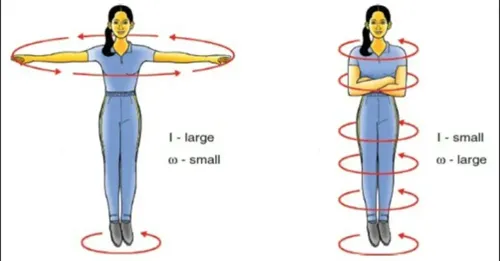
Momentum doesn't just apply to things moving in a straight line; it also governs rotation. While linear momentum relies on mass, rotational motion relies on the moment of inertia (how that mass is distributed) and angular velocity (how fast it spins).
Think of an ice skater spinning. When they stretch their arms out, their moment of inertia is higher, so their spin (angular velocity) slows down. When they pull their arms in tight to their chest, their moment of inertia drops, and they spin much faster. Because angular momentum in a closed system must remain stable, changing their shape instantly changes their speed.
The Engineering of the Universe
From a simple pendulum swinging to the complex destruction of a car crash, the rules of energy and momentum dictate exactly how our physical world behaves. These principles of conservation are some of the most profound fundamentals in physics. They not only pave the way for studying relativity and quantum mechanics, but they serve as the vital rules engineers rely on every day to design the world around us.