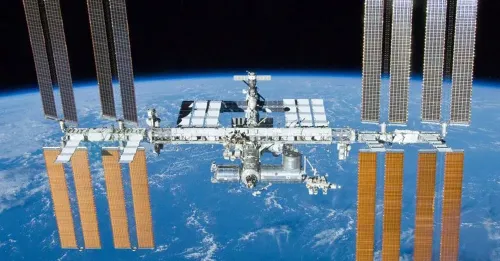
The International Space Station: A Laboratory in the Sky
The International Space Station (ISS) stands as one of humanity’s most remarkable achievements. A marvel of modern engineering and international collaboration, this facility serves as a beacon of scientific discovery orbiting high above our atmosphere. While many people are aware that it orbits Earth and hosts groundbreaking experiments, there are frequent misconceptions about its exact location and the physics that keep it afloat. Let’s dive into the reality of this unprecedented orbital outpost and explore how it continues to shape our understanding of the universe.
Closer Than You Might Think
When picturing the ISS, it is easy to imagine it floating thousands of kilometers out in deep space. A common misconception suggests the station operates at an altitude of 2,000 kilometers above the Earth’s surface. While 2,000 kilometers is indeed the upper boundary of Low Earth Orbit (LEO), the actual home of the ISS is much closer. The station orbits at an average altitude of approximately **400 kilometers** (about 250 miles). To put that into perspective, if you could drive a car straight up into the sky at highway speeds, you would arrive at the station in just a few hours. This relatively low altitude is absolutely crucial for safe astronaut transport and regular resupply missions.
An Unprecedented Scale
The current station is vastly larger than its predecessors, such as Skylab or Mir. Spanning roughly 108 meters in length, its massive footprint matches the size of an American football field. Because it is so large and orbits relatively close to the planet, its expansive solar arrays reflect a tremendous amount of sunlight back down to us. This powerful combination makes the ISS the third brightest object in the night sky. On a clear night, you do not need a telescope or binoculars to see it. It is easily visible to the naked eye, appearing as a bright, fast-moving star streaking silently across the darkness.
The Magic of Microgravity
Perhaps the most fascinating aspect of the ISS is its function as a microgravity laboratory. But why is there a state of weightlessness at just 400 kilometers up? At that specific altitude, Earth’s gravitational pull is actually still about 90 percent as strong as it is on the surface. The secret lies entirely in the station's orbital speed. The ISS travels sideways at a blistering 28,000 kilometers per hour (17,500 mph). At this incredible velocity, the station is in a continuous state of free-fall around the curvature of the Earth. It falls forward exactly as fast as the planet curves away beneath it.
This continuous free-fall creates a unique environment, allowing scientists to conduct biological, chemical, physical, and medical experiments that would be fundamentally impossible under normal terrestrial gravity. From studying cell biology to observing deep space weather, the ISS continually pushes the boundaries of human knowledge.
Next time you look up at the night sky, keep an eye out for that moving point of light. It is a bustling, world-class laboratory flying right above our heads, unlocking the secrets of the cosmos for everyone.