The Evolution of the Microscope: From Water Jars to Electrons
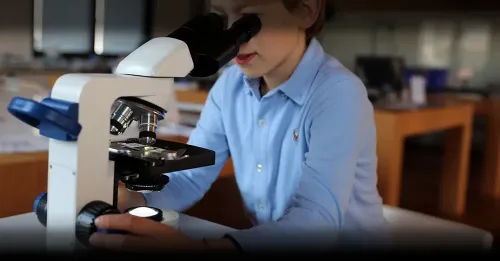
The microscope is undeniably one of the most important inventions in the history of science. Before its creation, our understanding of the world was limited entirely to what we could perceive with the naked eye. By magnifying objects that were otherwise invisible, this revolutionary device allowed humanity to discover an entire universe of microscopic organisms. However, the powerful microscopes we rely on in modern laboratories did not appear overnight. Their development required thousands of years of human ingenuity.
The Earliest Magnifiers
The fundamental concept of magnification has been utilized for roughly 3,000 years. Ancient civilizations discovered that filling curved glass jars with water created a natural magnifying effect. By the 1st century, the Romans began experimenting with more deliberate magnifying tools. Before high-quality glassmaking was perfected, early magnifiers—sometimes referred to as "reading stones"—were carefully carved out of clear rock crystal, such as quartz. These primitive lenses laid the early groundwork for optics, but it would take many centuries before true glass lenses became widely manufactured in the late 1200s, primarily for the creation of early spectacles.
The Birth of the True Microscope
The vital leap from simple magnifying glasses to actual microscopes occurred around 1590. A Dutch spectacle maker named Zacharias Janssen is widely credited with inventing the first compound microscope. By aligning two glass lenses inside a single sliding tube, Janssen created a device that could magnify objects significantly more than a single lens ever could. While these early models were often treated as novelty items and lacked the sharpness needed for intense scientific study, they introduced the compound lens system that serves as the foundation for the microscopes still used in classrooms today.
Discovering the Invisible World
The most dramatic breakthrough in early microscopy happened in the mid-1600s, thanks to a Dutch amateur scientist and lens grinder named Antonie van Leeuwenhoek. Unlike Janssen's compound design, Leeuwenhoek developed a highly unconventional, paddle-shaped microscope that utilized just one perfectly polished, tiny glass sphere. Despite its simple appearance, his handmade lenses were incredibly powerful, capable of magnifying objects up to 275 times. With this instrument, Leeuwenhoek became the first person to observe and describe single-celled bacteria and microbes. His work proved that a vast, invisible world of living organisms existed all around us, fundamentally changing the fields of biology and medicine forever.
Beyond Light: The Electron Revolution
Throughout the early 1800s, scientists continued to refine microscope technology, dramatically improving viewfinders, lenses, and lighting to create sharper, more reliable images. However, traditional light microscopes eventually hit a physical limit based on the wavelength of visible light itself. In 1931, scientists shattered this barrier by developing the first electron microscope. Instead of using visible light and glass lenses, this new technology utilized a concentrated beam of electrons to map the surface and interior of objects. This allowed for unprecedented magnification, letting scientists see the microscopic structures of individual viruses and atoms, and continuing a 3,000-year legacy of bringing the invisible into sharp focus.