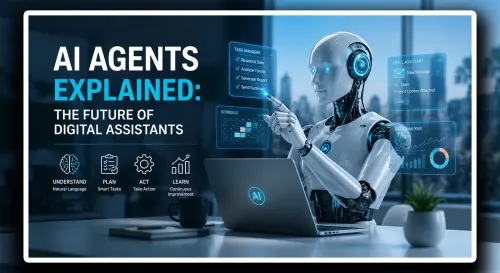
AI Agents Explained: The Future of Digital Assistants
The Next Evolution of Artificial Intelligence
Artificial Intelligence has transformed the way we interact with technology, from voice assistants and chatbots to advanced content-generation tools. The next major step in this evolution is AI agents — intelligent systems designed not only to answer questions but also to take actions, make decisions, and complete tasks on behalf of users.
Unlike traditional digital assistants that mainly respond to commands, AI agents can understand goals, plan multiple steps, and work independently to achieve desired outcomes.
What Are AI Agents?
AI agents are advanced AI systems that combine language understanding, reasoning, memory, and automation capabilities. They can analyze information, interact with different software tools, and complete complex workflows with minimal human input.
For example, instead of simply asking an assistant to “find a flight,” an AI agent could compare prices, check schedules, choose the best option based on your preferences, and prepare a booking request.
How Do AI Agents Work?
AI agents operate through several key technologies:
1. Large Language Models (LLMs)
Powerful AI models help agents understand human instructions, generate responses, and solve problems using natural language.
2. Memory Systems
AI agents can remember previous interactions, preferences, and important information to provide more personalized assistance.
3. Tool Integration
Unlike basic chatbots, AI agents can connect with applications, databases, websites, and business systems to perform real-world actions.
4. Autonomous Decision-Making
AI agents can break down complex goals into smaller tasks, evaluate options, and choose the best approach to complete objectives.
AI Agents vs Traditional Digital Assistants
Traditional assistants like simple chatbots mainly provide information when users ask questions. AI agents go further by actively working toward a goal.
For example, a traditional assistant might tell you how to organize a meeting, while an AI agent could schedule the meeting, send invitations, prepare an agenda, and follow up with participants automatically.
How AI Agents Will Change Our Future
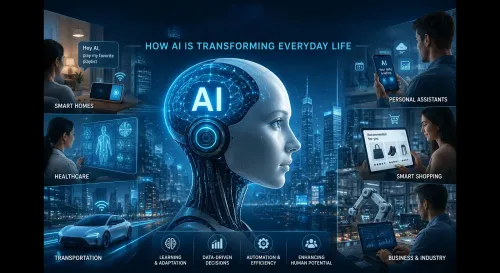
AI agents are expected to transform industries such as healthcare, education, business, finance, and software development. Companies can use AI agents to automate repetitive tasks, improve customer service, and increase productivity.
In personal life, AI agents may become intelligent digital partners that manage daily schedules, shopping, travel planning, and personal projects.
Challenges and the Road Ahead
Despite their potential, AI agents still face challenges including privacy concerns, security risks, reliability issues, and ethical questions. Ensuring that AI systems act safely and transparently will be essential as adoption grows.
A New Era of Digital Assistance
AI agents represent a significant shift from passive digital assistants to proactive intelligent partners. As technology continues to advance, these systems could redefine how humans interact with computers, making everyday tasks faster, smarter, and more efficient. The future of digital assistance is not just about answering questions — it is about taking action.