Cybersecurity Trends: Protecting Your Data in a Connected World
In today's digital age, cybersecurity has become one of the most critical concerns for individuals, businesses, and governments alike. As more devices connect to the internet and organizations increasingly rely on cloud-based services, the volume of sensitive data being generated, stored, and transmitted continues to grow. While these technological advancements bring tremendous benefits, they also create new opportunities for cybercriminals.
As cyber threats become more sophisticated, understanding the latest cybersecurity trends is essential for protecting valuable information and maintaining trust in an increasingly connected world.
Why Cybersecurity Matters More Than Ever
The modern world is powered by digital technologies. From online banking and e-commerce to remote work and smart homes, people depend on connected systems every day. Unfortunately, cybercriminals target these systems to steal personal information, disrupt operations, and demand financial payments through ransomware attacks.
A successful cyberattack can result in financial losses, reputational damage, legal consequences, and compromised customer trust. As a result, cybersecurity has evolved from an IT concern into a strategic business priority.
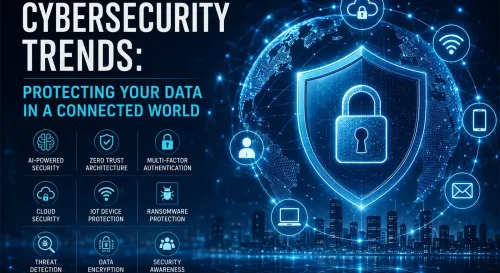
1. AI-Powered Cybersecurity
Artificial Intelligence (AI) is transforming both cyberattacks and cyber defense. Security teams are increasingly using AI-powered tools to detect suspicious behavior, analyze large volumes of data, and identify threats in real time.
Machine learning algorithms can recognize unusual patterns that may indicate malware infections, unauthorized access attempts, or insider threats. By automating threat detection and response, AI helps organizations react faster and reduce potential damage.
2. Zero Trust Security Architecture
Traditional security models often assumed that users inside a network could be trusted. However, modern cybersecurity strategies are shifting toward a Zero Trust approach.
The principle of Zero Trust is simple: "Never trust, always verify."
Every user, device, and application must continuously prove its identity before accessing resources. This approach reduces the risk of unauthorized access and limits the spread of attacks within an organization's network.
3. Multi-Factor Authentication (MFA)
Passwords alone are no longer sufficient to protect sensitive information. Cybercriminals frequently use phishing attacks, credential theft, and password-cracking techniques to gain access to accounts.
Multi-Factor Authentication adds an additional layer of security by requiring users to verify their identity through multiple methods, such as:
PasswordsMobile authentication apps
Security keys
Biometric verification
Organizations adopting MFA significantly reduce the likelihood of account compromise.
4. Rise of Ransomware Protection
Ransomware remains one of the most dangerous cybersecurity threats. Attackers encrypt data and demand payment in exchange for restoring access.
To combat ransomware, organizations are investing in:
Advanced threat detection systemsRegular data backups
Employee cybersecurity training
Endpoint protection solutions
Incident response planning
Proactive defense strategies help minimize the impact of ransomware attacks and improve recovery capabilities.
5. Cloud Security Enhancement
Cloud computing continues to drive digital transformation, but it also introduces new security challenges. Businesses must secure cloud applications, storage systems, and remote access points.
Modern cloud security strategies include:
Encryption of sensitive dataIdentity and access management
Continuous security monitoring
Automated compliance checks
Secure cloud configuration management
As cloud adoption grows, cloud security remains a top priority for organizations worldwide.
6. Internet of Things (IoT) Security
Smart devices are becoming increasingly common in homes, workplaces, healthcare facilities, and industrial environments. However, many IoT devices were not originally designed with strong security protections.
Cybersecurity experts are focusing on:
Secure device authenticationFirmware updates
Network segmentation
Device monitoring
Vulnerability management
Protecting IoT ecosystems is essential as billions of connected devices continue to enter the market.
7. Human-Centered Security Awareness
Technology alone cannot prevent every cyberattack. Human error remains one of the leading causes of security incidents.
Organizations are investing in employee training programs that teach users how to:
Recognize phishing emailsCreate strong passwords
Avoid suspicious links
Protect sensitive information
Follow security best practices
Creating a culture of cybersecurity awareness significantly strengthens overall security posture.
Emerging Threats to Watch
Cybersecurity professionals are also preparing for several emerging threats, including:
Deepfake Attacks
AI-generated audio and video can impersonate executives, employees, or public figures to facilitate fraud and social engineering attacks.
Supply Chain Attacks
Attackers increasingly target software vendors and third-party providers to gain access to multiple organizations through a single compromise.
Quantum Computing Risks
Although still developing, future quantum computers may eventually challenge current encryption standards, prompting research into quantum-resistant cryptography.
Best Practices for Protecting Your Data
Whether you are an individual or a business, following these cybersecurity best practices can help reduce risk:
Enable Multi-Factor Authentication on all critical accounts.
Keep software and devices updated.Use strong, unique passwords.
Regularly back up important data.
Be cautious when opening emails and attachments.
Encrypt sensitive information.
Monitor accounts for suspicious activity.
Educate employees and family members about cyber threats.