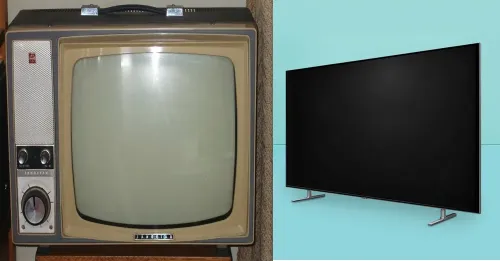
The Evolution of "Remote Vision": A Brief History of Television
Whether you are binge-watching your favorite series, catching up on global news, or popping in a classic DVD, television has undoubtedly shaped the modern world. But how much do you actually know about the box in your living room?
Let’s take a journey through the history and evolution of the television—a widely used communication device that has grown from a quirky novelty into a global powerhouse of entertainment and broadcasting.
What Exactly Is a Television?
The word “television” can mean a few different things: the physical set in your home, the programming you watch, or the act of broadcasting itself. At its core, it is a device that transmits and captures single-color (black and white) or full-color images, usually paired with audio.
Interestingly, the word itself tells you exactly what it does. Derived from a mix of Greek and Latin, “tele” (Greek for “remote”) and “viso” (Latin for “scene” or “vision”), television quite literally translates to remote vision.
The Early Pioneers and First Broadcasts
The journey of "remote vision" didn't happen overnight. It was marked by several groundbreaking milestones:
- 1926: The first experimental television broadcast was successfully made by Scottish engineer Zun Logi Byard.
- Late 1930s: Television sets officially hit the consumer market. Initially, they were considered an incredible luxury—comparable in status to owning a luxury car!
- 1936: The British Broadcasting Corporation (BBC) launched the world's very first television channel.
In the beginning, these devices faced skepticism. Early models were often viewed as mere toys, and because of early design quirks (like slanted screens or distorted images), they were initially unpopular. However, it didn't take long for the tide to turn. Within just three years of hitting the broader market, more than 30,000 television sets were installed in homes, cementing TV as a major communication tool for businesses, organizations, and everyday entertainment.
The Color Revolution and Going Global
As television became more widely used, the technology rapidly improved. Black-and-white screens eventually gave way to a more vibrant viewing experience. In 1951, the United States launched the very first color television broadcast, changing the medium forever.
With television becoming an incredibly effective means of disseminating important news, broadcasters needed a way to reach remote areas. The solution was in the stars:
- 1963: The first satellite used for television broadcasts, Telstar, successfully connected Europe to the United States, proving that TV could be a truly global phenomenon.
From Analog to Digital: The Anatomy of a TV
By the 1970s, the television experience began to expand. Audio and video recordings became available, allowing users to do more than just watch live broadcasts. Eventually, the television evolved to capture and display digital media, such as DVDs.
But what makes a TV?
A typical television set contains specific electronic circuits designed to carry out radio tuning and convert incoming video signals into the original images and audio.
Fun Fact: If an imaging device does not include these specific tuning and conversion circuits, it is technically called a monitor, not a television!
Today, the technology has expanded far beyond those early conventional broadcasts. The foundational technology of television has been adapted and built upon for complex systems, including security cameras, high-definition television (HDTV), and modern digital TV.
From a disputed luxury "toy" to an essential fixture in billions of homes, the television has truly lived up to its name, bringing remote scenes directly into our living rooms for nearly a century.