From Galileo to Lorentz: Understanding the Speed of Causality
Why the universal speed limit isn't just about light—it's about the fundamental rules of cause and effect.
We often hear that c stands for the speed of light. While it's true that light travels at this speed, calling it the "speed of light" misses a much deeper truth about our universe. Fundamentally, c is the speed of causality—the absolute maximum speed at which one event can influence another.
To understand why, we have to look at a historic clash between two giants of physics.
The Clash: Galileo vs. Maxwell
Galileo established a principle of relativity that feels perfectly aligned with everyday common sense: all experiments must yield the same results under constant velocity, and total velocity is just the sum of its parts. If you are on a moving ship and throw a ball forward, the ball's total speed to an observer on the shore is your throwing speed plus the ship's speed.
But this Galilean transformation runs into a massive problem when we introduce James Clerk Maxwell. Maxwell's equations govern electromagnetism and dictate that the speed of electromagnetic waves (like light) is a constant.
Imagine an electrician on a fast-moving ship holding a light beam. According to Galileo, the light's total speed should be the speed of the light plus the speed of the ship. If you chased a light beam fast enough, you could theoretically catch it and see it frozen in place. But Maxwell's equations don't allow for a stationary electromagnetic wave. So, who was right?
Breaking the Absolute: The Lorentz Transformation
As it turns out, Galileo was wrong—at least when it comes to extreme speeds. Galilean relativity works perfectly for everyday, slow-moving objects, but it completely breaks down as you approach c. In Galileo's universe, time and space are absolute, and the speed of light would essentially have to be infinite.
To resolve this contradiction, physicist Hendrik Lorentz developed the Lorentz transformation. Lorentz revealed that space and time are not separate, rigid stages, but a connected, flexible fabric called spacetime.
Instead of velocities simply stacking on top of each other infinitely, space contracts and time dilates. These transformations ensure that the speed of light remains a constant parameter, no matter how fast the observer is moving or where they are positioned.
The Ultimate Speed Limit
Maxwell proved that electromagnetic waves travel at this set, maximum speed. But why is it a universal limit?
It comes down to mass. Only particles without mass—like photons—can travel at c. The moment a particle has mass, that mass creates an obstruction. As Einstein later revealed with
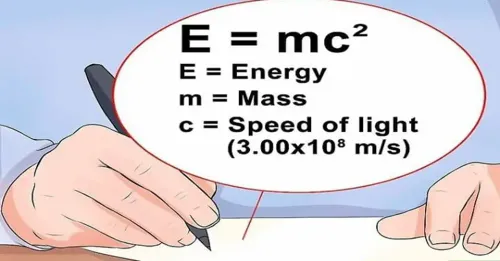
, mass and energy are fundamentally interchangeable. Trying to accelerate even a tiny mass to c would require an infinite amount of energy.
Because nothing with mass can reach c, and no information can travel faster than c without breaking the geometric order of spacetime (which would allow an effect to happen before its cause), c is not merely the speed at which light happens to travel. It is the absolute, unchanging speed limit of cause and effect in the universe.