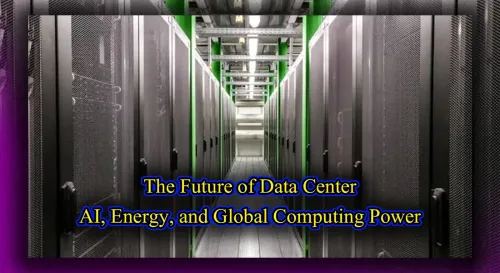
The Future of Data Centers: AI, Energy, and Global Computing Power
The global data center landscape is undergoing a radical transformation. Driven by the demands of artificial intelligence (AI), data centers are no longer passive storage warehouses ( they are the high-performance engines of the global economy ). This computing revolution, however, comes with a massive footprint, sparking an unprecedented race for energy, efficiency, and infrastructural innovation.
The AI Compute Crisis
For decades, data center growth mirrored standard cloud computing. Generative AI completely rewrote that trajectory. Training large language models (LLMs) requires exponential computational density. Instead of traditional central processing units (CPUs), modern data centers are packed with power-hungry graphics processing units (GPUs) and specialized AI accelerators.
Consequently, power density has skyrocketed. A decade ago, an average server rack required 3 to 5 kilowatts (kW) of power. Today, AI-optimized racks regularly demand 40 to 100 kW. To keep pace, global data center capacity must double in the coming years.
The Energy Bottleneck
The most pressing challenge isn't chip shortages—it is raw electrical power. Data centers currently consume roughly 2% of global electricity, but some projections suggest this figure will surpass 5% by the end of the decade. In hyper-scale hubs like Northern Virginia and Singapore, utilities face severe grid constraints and connection delays, prompting tech giants to pivot toward alternative energy strategies:
Nuclear Energy: Companies are signing power purchase agreements (PPAs) and investing in Small Modular Reactors (SMRs) to secure 24/7 carbon-free baseline power.Advanced Renewables: Operators are exploring deep geothermal energy for consistent, weather-independent green power.
Microgrids: Massive battery storage allows facilities to support the main grid during peak demand rather than just draining it.
Redefining Architecture
As chips run hotter, physical architecture is being fundamentally reinvented. Traditional raised-floor air conditioning is insufficient for high-density clusters. The industry is shifting toward liquid cooling, piping coolant directly to chips or submerging entire servers in specialized, non-conductive dielectric fluid to drastically slash energy use.
Furthermore, while hyperscale facilities handle heavy training workloads, running real-time AI requires low latency. This is driving the rapid growth of Edge Data Centers — localized facilities placed closer to urban hubs and smart factories, creating a hybrid computing ecosystem.
The Geopolitical Shift
Computing power is now effectively a form of sovereign wealth. Historically concentrated in Western markets, data center development is migrating to regions offering two critical resources: abundant land and cheap, accessible energy. Countries with massive renewable assets—like the Nordics (hydroelectric), the Middle East (solar), and emerging markets across Southeast Asia—are becoming premium real estate for housing the next generation of global computing infrastructure.