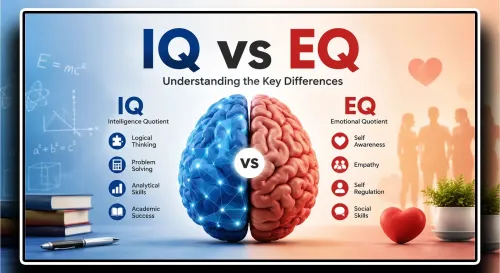
IQ vs. EQ: Why Being Smart Isn't the Whole Story
We've all met that person — the one who aced every exam, breezed through calculus, maybe even got into a great university — and then somehow can't read a room to save their life. And we've all met the opposite: someone who isn't going to win any trivia contests but has this uncanny ability to calm people down, win them over, or know exactly what to say when things get tense. That contrast is basically the whole IQ-versus-EQ conversation in a nutshell.
So what actually is IQ?
IQ is the one most of us grew up hearing about — it's shorthand for how well someone reasons, solves problems, remembers things, and works through abstract or mathematical ideas. It's the kind of intelligence school is built around, which is why people with high IQs tend to do well in academic settings or technical fields where there's a clear right answer and getting there requires sharp logic.
And EQ?
EQ gets talked about less, but honestly it might matter more day-to-day. It's your ability to notice what you're feeling, keep those feelings in check when it counts, pick up on what other people are feeling, and actually do something useful with that awareness — whether that's calming a friend down, defusing an argument, or just knowing when to bite your tongue. Psychologists usually break it into a few pieces: self-awareness, self-regulation, empathy, motivation, and social skill. None of that shows up on a standardized test, but you feel its absence immediately when you're dealing with someone who doesn't have it.
Where they really diverge
The biggest difference isn't just what they measure — it's how fixed each one is. IQ is famously stubborn. It's shaped early and, short of major life changes, doesn't move around much once you're an adult. EQ is the opposite story. It's less a fixed trait and more a skill — clumsy at first, but something you can genuinely get better at with practice, feedback, and a bit of humility about your own blind spots.
They also get measured completely differently. IQ has its neat, standardized tests with a number at the end. EQ doesn't have anything nearly as tidy — it's inferred from how people behave, how they handle conflict, how self-aware they are when you ask them to reflect on a tough moment.
Why you kind of need both
A brilliant strategist who can't collaborate will eventually hit a ceiling — people stop wanting to work with them, no matter how good their ideas are. And someone with all the empathy in the world but none of the technical chops will struggle in a field that demands deep expertise. The people who actually go far — the ones running companies, leading teams, building things that last — tend to have a real mix of both. They can think clearly under pressure and read the people around them well enough to bring those people along.
If you're trying to build your EQ specifically
Unlike IQ, this one's actually trainable, and it doesn't require anything dramatic:
- Actually listen when someone's talking, instead of half-listening while you plan your response
- Try to see situations from other people's angle, even when it's inconvenient
- Find healthier ways to deal with stress before it spills over onto other people
- Get honest with yourself about why you reacted the way you did in a hard moment
- Work on saying what you mean clearly, without over-explaining or under-explaining
Neither IQ nor EQ tells the whole story on its own. IQ gives you the horsepower to think, analyze, and solve. EQ is what lets you actually connect with people and lead them somewhere. The people who do best in life usually aren't the smartest in the room or the most likeable — they're the ones who've put real work into both.