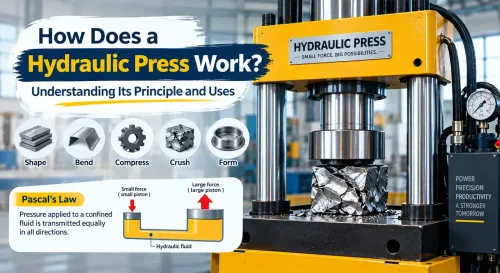
How Does a Hydraulic Press Work? Understanding Its Principle and Uses
A hydraulic press is a powerful machine that can produce a large amount of force using hydraulic fluid. It is widely used in manufacturing, automotive repair, metalworking, construction, and many other industries. Although the machine may look complicated, its basic working principle is actually quite simple. A hydraulic press works mainly through Pascal’s Law, which allows pressure in a confined fluid to be transferred equally in all directions.
What Is a Hydraulic Press?
A hydraulic press is a machine designed to compress, shape, bend, or lift materials by using fluid pressure. The main components usually include a hydraulic cylinder, pistons, hydraulic pump, reservoir, valves, hydraulic oil, and a strong supporting frame.
The hydraulic oil plays an important role because it transfers pressure from one part of the system to another.
How Does a Hydraulic Press Work?
The working process begins when the hydraulic pump moves hydraulic oil into the cylinder. This creates pressure inside the system. The pressure pushes against a piston, causing it to move downward or upward depending on the design of the machine.
The most important principle behind this process is Pascal’s Law. It states that when pressure is applied to a confined liquid, that pressure is transmitted equally throughout the liquid.
A hydraulic press normally uses two pistons with different surface areas. When a small amount of force is applied to the smaller piston, it creates pressure in the hydraulic fluid. The pressure then reaches the larger piston. Because the larger piston has a greater surface area, it produces a much larger force.
This force can then be used to press, shape, crush, or move heavy objects.
Common Uses of Hydraulic Presses
Hydraulic presses are used for many different tasks. In factories, they can shape and form metal parts, manufacture machine components, and mold materials. In automotive workshops, hydraulic presses are commonly used to remove bearings, repair parts, and perform other heavy-duty tasks.
They are also used for crushing materials, compacting waste, and producing various industrial products.
A hydraulic press is a powerful machine based on a simple scientific principle. By using hydraulic fluid and Pascal’s Law, it can multiply force and perform tasks that would be difficult or impossible with human strength alone. This combination of power, precision, and reliability makes hydraulic presses essential in many modern industries.