Battery Chemistry Face-Off: LiFePO4 vs. NMC Lithium-Ion vs. Lead-Acid
Choosing the right battery chemistry comes down to balancing weight, lifespan, safety, and upfront cost. Whether designing an off-grid solar setup, outfitting a campervan, or selecting power storage for commercial and mobile applications, three core chemistries dominate the market: Lead-Acid, Lithium-Ion (NMC/LCO), and Lithium Iron Phosphate (LiFePO4).
Each chemistry brings distinct trade-offs in energy density, cycle resilience, and thermal stability.
Quick Comparison at a Glance
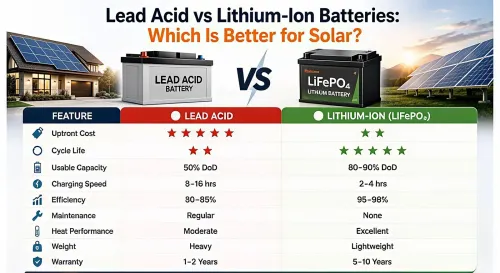
| Metric | Lead-Acid (AGM / Gel) | Lithium-Ion (NMC) | LiFePO4 (LFP) |
| Usable Depth of Discharge (DoD) | 50% | 80%–90% | 90%–100% |
| Typical Cycle Life (to 80% Capacity) | 300–800 cycles | 1,000–2,000 cycles | 3,000–5,000+ cycles |
| Gravimetric Energy Density | Very Low (~30–50 Wh/kg) | Very High (~150–250 Wh/kg) | Moderate (~90–140 Wh/kg) |
| Nominal Cell Voltage | 2.0 V / cell | 3.6 V – 3.7 V / cell | 3.2 V / cell |
| Thermal Runaway Threshold | ~160°C (Off-gasses hydrogen) | ~200°C–210°C (Self-oxidizing fire) | ~270°C (Extremely stable) |
| Cost Profile | Lowest initial cost | Moderate initial cost | Higher upfront, lowest per-cycle cost |
Lead-Acid Batteries: The Heavyweight Veteran
First developed in the mid-19th century, lead-acid technology remains widespread in automotive SLI (starting, lighting, ignition) systems, industrial backup power, and budget off-grid configurations. Modern sealed variations include Absorbent Glass Mat (AGM) and Gel chemistries.
The Goods:
Lowest Initial Upfront Cost: Readily accessible and cheap per gross kilowatt-hour, making it attractive for budget-conscious builds.
Proven Cold-Cranking Amps (CCA): Excellent surge current delivery for internal combustion engine starters, even in freezing ambient temperatures.
Established Recycling Infrastructure: Boasts an established closed-loop recycling rate exceeding 95% across North America and Europe.
Tolerant Float Operation: Holds up well under continuous trickle/float charging when held at 100% state of charge.
The Weaknesses:
Restricted Usable Capacity: Discharging beyond 50% Depth of Discharge accelerates sulfation on the lead plates, cutting cycle life drastically.
Severe Peukert Effect: Rapid discharge rates substantially decrease the total deliverable capacity of the pack.
Short Lifespan: Daily cycling demands replacement every 2 to 4 years.
Excess Bulk and Weight: Low energy density penalizes payload limits in mobile, marine, and vehicular systems.
Slow Bulk & Absorption Stages: Takes significantly longer to reach full charge due to internal resistance in the absorption phase.
NMC Lithium-Ion: Maximum Energy in Minimum Space
Nickel Manganese Cobalt (NMC) and related cobalt-rich lithium chemistries (such as NCA and LCO) dominate consumer electronics, power tools, and high-performance electric vehicles. Their design focuses primarily on pack compactness and high power-to-weight ratios.
The Goods:
Industry-Leading Energy Density: Delivers up to 250 Wh/kg, packing considerable stored energy into tight, lightweight enclosures.
High Discharge C-Rates: Capable of delivering continuous high amp draws without steep voltage drop, making it suitable for rapid acceleration and heavy motorized loads.
Compact Integration: Flexible cell geometries (prismatic, cylindrical, or pouch) allow for ultra-slim battery module integration.
The Weaknesses:
Thermal Runaway Vulnerability: The cathode structure begins releasing internal oxygen at approximately 200°C. In the event of a puncture, short, or overcharge, fire risk is high and difficult to extinguish.
Moderate Cycle Longevity: Degradation begins accelerating after 1,000 to 1,500 cycles, especially if kept at full charge in hot environments.
Stringent Battery Management Requirements: Requires rigorous multi-channel BMS monitoring to prevent over-voltage, thermal build-up, and cell imbalance.
Supply Chain Scrutiny: Relies on cobalt and nickel extraction, which carry geopolitical, environmental, and price volatility factors.
LiFePO4 (LFP): Safety and Lifespan Champion
Lithium Iron Phosphate replaces cobalt and nickel with an iron and phosphate cathode. The covalent P–O chemical bond provides exceptional structural and thermal integrity, making LiFePO4 the benchmark for stationary energy storage and auxiliary power.
The Goods:
Uncompromising Safety: The stable chemical structure prevents oxygen release under stress. The thermal runaway threshold sits around 270°C (518°F), meaning mechanical puncture or moderate overcharging typically causes venting and heat, not explosive flame.
Exceptional Cycle Endurance: Yields 3,000 to 5,000+ cycles at 80% to 90% DoD. When used daily, packs often operate reliably for 10 to 15 years.
Flat Discharge Curve: Voltage stays rock-solid around 12.8V to 13.2V across 85% of the discharge cycle, protecting sensitive electronics and inverters from low-voltage brownouts.
Rapid Charging Capability: Can accept high charge currents (0.5C to 1C) safely, dropping replenishment times to 1–2 hours when paired with adequate solar or alternator chargers.
The Weaknesses:
Volumetric & Weight Penalty vs. NMC: Sits roughly 30% to 50% heavier and bulkier than NMC packs of matching storage capacity.
Higher Upfront Price Point: Initial capital outlay is 3x to 5x that of equivalent-capacity flooded or AGM lead-acid batteries.
Sub-Zero Charging Restrictions: Charging standard LFP cells below 0°C (32°F) causes irreversible lithium metal plating on the anode, destroying cell capacity unless equipped with low-temp cutoff sensors or integrated internal heating pads.