Uranium and Nuclear Fission: From Chain Reaction to Critical Mass
Uranium stands as the fundamental element driving the modern nuclear age. Found naturally across the globe yet concentrated in only a few rich ore deposits, this heavy metal has shaped global geopolitics, energy production, and military strategy. Extracted from both deep underground tunnels and massive open-pit mines, refined uranium possesses unique physical and chemical characteristics that unlock the immense power hidden deep inside the atomic nucleus.
The Metallic Nature and Isotopes of Uranium
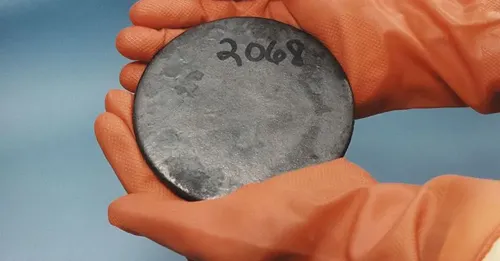
Uranium is a naturally radioactive, incredibly dense, and silvery-white metal. While it is hard, it remains malleable enough to be easily formed and processed. In the presence of atmospheric oxygen, it quickly oxidizes, covering its surface in a dark uranium oxide layer.
In its natural state, uranium is overwhelmingly composed of the isotope U-238. In fact, the natural distribution of the metal follows a strict ratio:
Out of every 1,000 uranium atoms found in nature, 993 are U-238, while a mere 7 are the highly fissile U-235.
It is this rare 0.7% composition of U-235 that makes the refinement and enrichment processes so vital for nuclear applications, as U-238 cannot easily sustain a nuclear reaction on its own.
The Mechanics of Nuclear Fission
The true power of uranium is unleashed through a process known as nuclear fission. Fission occurs when a free neutron collides with the nucleus of a fissile atom, like U-235. Upon absorbing the incoming neutron, the nucleus becomes highly unstable and violently splits apart into smaller fragments. This splitting action converts a tiny fraction of the atom's original mass into a massive burst of pure thermal and kinetic energy, while simultaneously ejecting two to three secondary neutrons.
Exponential Chains and Critical Mass
For fission to be useful, it cannot be a standalone event; it must become an evolutionary chain reaction. The secondary neutrons released during the initial split fly outward to strike neighboring U-235 atoms. If these neutrons successfully trigger subsequent splits, the number of active neutrons multiplies exponentially.
However, this reaction can only sustain itself if there is a dense enough concentration of fissile material packed together. The minimum amount of matter required to maintain a continuous, self-sustaining nuclear chain reaction is scientifically defined as the critical mass.
Controlled Energy versus Destructive Power
The core difference between peaceful nuclear energy and devastating nuclear weapons lies entirely in how this chain reaction is managed.
Nuclear Power Plants: The fission process is meticulously controlled. Operators use specialized control rods made of neutron-absorbing materials (like boron) to regulate the environment. This keeps the reaction slow, steady, and safe, generating continuous heat to produce electricity.
Nuclear Weapons: The chain reaction is intentionally uncontrolled. The critical mass is forced together rapidly, allowing the fission rate to multiply exponentially in milliseconds, triggering an instantaneous, catastrophic release of energy.
Ultimately, whether harvesting clean energy or constructing defensive deterrents, modern human engineering relies entirely on mastering the delicate balance of this volatile metal.