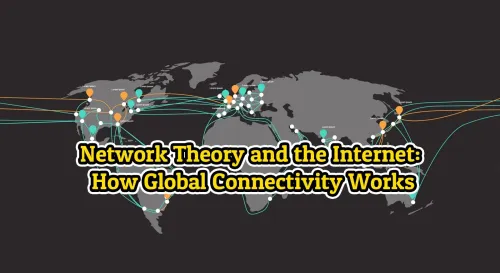
Network Theory and the Internet: How Global Connectivity Works
Every time you load a webpage or stream a video, data travels thousands of miles in a fraction of a second. It feels instantaneous, but underneath lies a massive mathematical framework known as network theory.
To understand how global connectivity operates, we can strip the internet down to its fundamental core architecture.
1. The Building Blocks: Nodes and Edges
In network theory, any connected system can be broken down into two main elements:
Nodes: The individual endpoint devices and connection hubs. On the internet, nodes include laptops, smartphones, web servers, routers, and giant data centers.
Edges: The pathways linking those nodes together. These range from undersea fiber-optic cables spanning continents to wireless signals over local Wi-Fi networks.
Together, these elements form a dynamic graph that determines how information flows around the globe.
2. Structural Design: Scale-Free Networks and Hubs
The internet isn't connected like a random spiderweb. Instead, it operates as a scale-free network.
Most nodes, like your home router, have only a few local connections. However, a small percentage of nodes act as massive hubs. These super-connected points belong to major Internet Service Providers (ISPs), cloud platforms, and internet exchange points.
Because of these central hubs, the web exhibits the small-world phenomenon: any two devices on Earth are typically separated by only a few quick "hops" across high-capacity data highways.
3. Dynamic Flow: Packet Routing and System Resilience
When you send a message, protocols chop the data into small packets. Network routers continuously monitor traffic conditions to dynamically steer each packet along the fastest available path to its destination.
This structural design makes the internet remarkably resilient. If an undersea cable breaks or a server goes offline, traffic automatically reroutes around the point of failure without interrupting the broader system.
Understanding network theory reveals that global connectivity isn't just about physical wires and computers—it's the clever mathematical architecture that keeps our digital world fast, efficient, and virtually indestructible.