Generative AI Explained: How Machines Are Creating Text, Images, Music, and Videos
Generative Artificial Intelligence (Generative AI) is transforming the way people create content. From writing articles and designing digital artwork to composing music and producing realistic videos, this technology enables machines to generate original content within seconds. Unlike traditional AI, which mainly analyzes or classifies information, Generative AI creates entirely new outputs based on patterns learned from massive datasets. As the technology continues to evolve, it is becoming an essential tool for businesses, educators, creators, and everyday users.
How Does Generative AI Work?
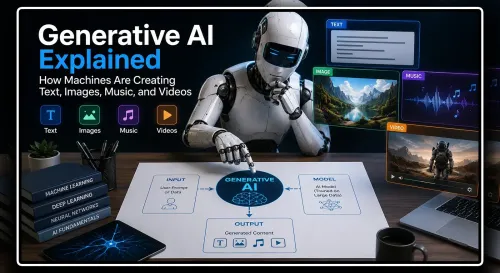
Generative AI relies on advanced machine learning models trained on billions of examples, including text, images, audio, and video. These models identify relationships, patterns, and structures within the data. When a user provides a prompt, the AI predicts and generates content that closely matches the request.
Modern AI systems use neural networks and large language models (LLMs) to understand context, produce natural language, and generate creative outputs that often resemble human work.
What Can Generative AI Create?
Generative AI supports a wide range of creative tasks, including:
Text: Blog posts, emails, reports, stories, and coding assistance.
Images: Digital artwork, product designs, illustrations, and marketing graphics.
Music: Original songs, instrumental tracks, background music, and sound effects.
Videos: AI-generated animations, talking avatars, promotional videos, and realistic visual content.
Its versatility makes it valuable across industries such as education, entertainment, healthcare, software development, and digital marketing.
Benefits and Challenges
One of the biggest advantages of Generative AI is its ability to boost productivity and creativity. It helps automate repetitive tasks, speeds up content creation, and provides inspiration for new ideas. Small businesses can produce professional-quality content without large creative teams.
However, challenges remain. AI-generated content can sometimes contain factual errors, reflect biases from training data, or raise concerns about copyright and misinformation. Responsible use and human review are essential to ensure accuracy and ethical outcomes.
The Future of Generative AI
As Generative AI continues to improve, it will become even more integrated into everyday life. Future systems are expected to create more personalized, realistic, and interactive experiences while collaborating with humans rather than replacing them. Understanding how this technology works today will help individuals and businesses prepare for a future where AI-powered creativity becomes the new standard.