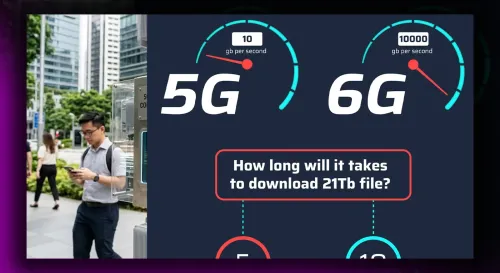
5G to 6G: How Next-Generation Connectivity Will Power the Future
We are currently witnessing the profound impact of 5G connectivity, a technology that brought gigabit speeds and low latency to mobile devices. However, as our digital ambitions rapidly expand toward fully autonomous vehicles, immersive extended reality, and advanced artificial intelligence, the ultimate limits of current networks are slowly becoming visible.
Enter 6G, the highly anticipated sixth generation of mobile connectivity. Although this technology is not expected to launch commercially until the early 2030s, researchers are actively laying the crucial groundwork today. This new standard will fundamentally redefine what is possible.
An Exponential Leap in Performance
The technical leap from 5G to 6G is incredibly massive. While 5G peaks around twenty gigabits per second, 6G targets blistering data rates reaching one terabit per second. This represents a fiftyfold increase. Furthermore, latency will drop from one millisecond to a staggering one hundred microseconds. Capacity will also explode, allowing up to ten million connected devices per square kilometer, an absolute necessity for heavily populated smart cities and automated factories.
Entering the Terahertz Frontier
To achieve these phenomenal speeds, 6G must utilize new segments of the electromagnetic spectrum, specifically the terahertz and sub-terahertz bands. These extreme frequencies act like massive superhighways for digital data, offering unprecedented bandwidth. Because terahertz waves travel much shorter distances and struggle to penetrate solid obstacles, engineers are developing innovative hardware. We will see dense networks of microscopic antennae and smart reflective surfaces designed to bounce signals around physical barriers.
AI-Native Networks and Environmental Sensing
Beyond raw speed, the fundamental nature of the network will transform. Today, 5G uses artificial intelligence as a helpful optimization tool. In stark contrast, 6G will feature an artificial intelligence-native architecture. The network will autonomously manage heavy traffic, predict system outages, and route resources dynamically based on fluctuating real-time global demand.
Additionally, 6G introduces integrated sensing and communication capabilities. Future networks will function essentially as highly precise radar systems. The exact signals transmitting your data will simultaneously map the physical environment, track autonomous drone flights, and detect moving objects without requiring any separate, dedicated sensors. The digital and physical worlds will seamlessly merge.
Transforming Science Fiction into Reality
What does this mean for humanity? This extraordinary level of connectivity transforms science fiction into reality. We will experience seamless holographic communication, interact with perfect digital twins of entire physical cities, and enable remote robotic surgeries where specialists across the globe operate with absolutely zero lag. Medical, industrial, and social landscapes will never be the same. The ultimate technological convergence is approaching faster than we ever thought was practically possible.
The Foundation for Tomorrow
As we move through the remainder of this current decade, the continuous evolution of our wireless infrastructure remains vitally important. Though you cannot purchase a 6G smartphone today, the invisible foundations being built right now will soon power a society limited only by human imagination. We are truly standing at the threshold of a revolutionary era in global telecommunications history. The transition from 5G to 6G is not merely an upgrade; it is the essential catalyst for our deeply interconnected tomorrow.